Russian losses in October 2026: a record 49,000 casualties before the month is over
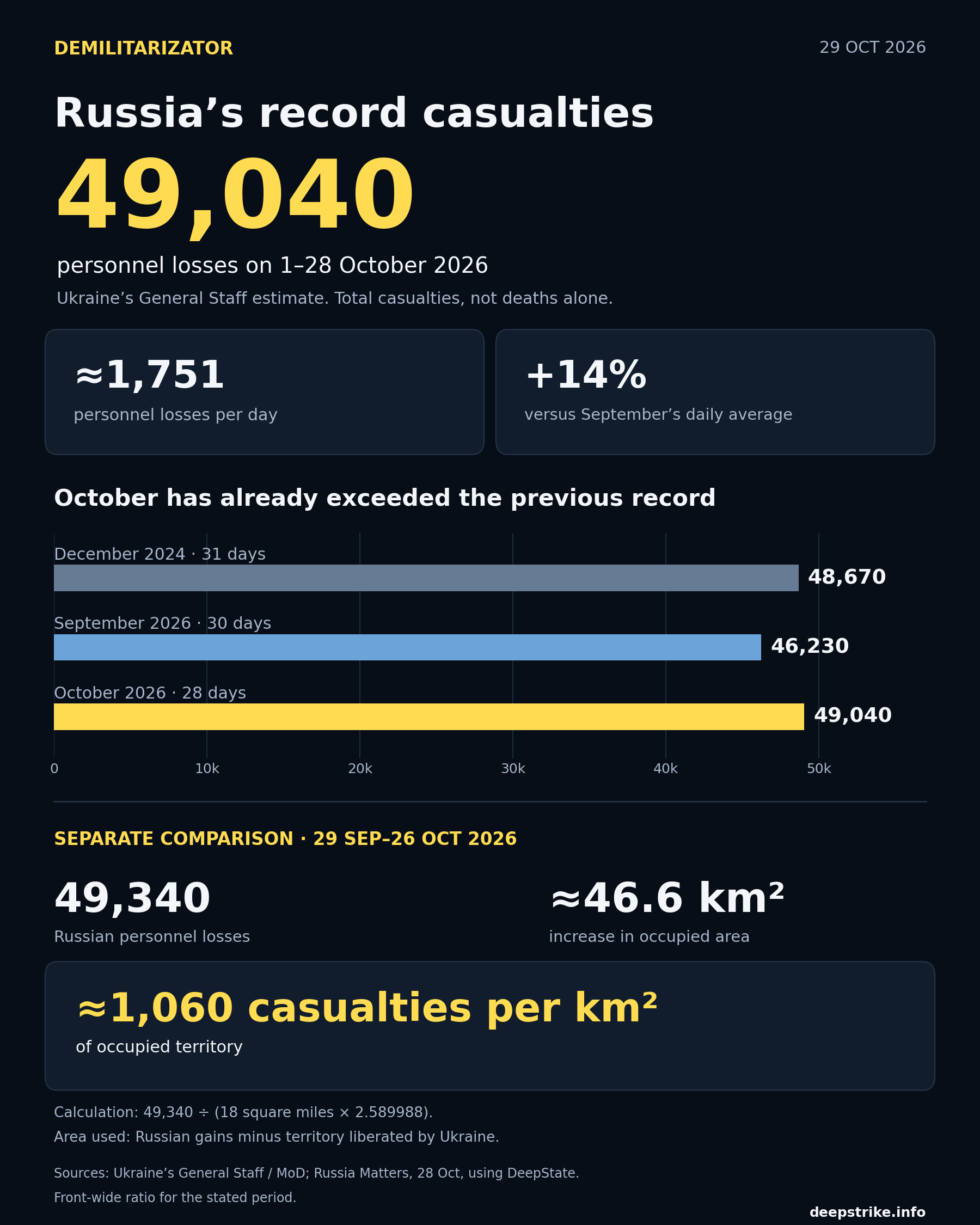
Russian personnel losses reached 49,040 in the first 28 days of October. According to Ukraine’s General Staff, that is more than in any full month since the full-scale invasion began. Those enormous losses have not delivered Russia’s main offensive objectives.
The record was reported on the morning of 29 October, with three days of the month still to go. The previous peak, 48,670, had stood since December 2024.
Behind these figures is an increasingly expensive war for Russia. The Kremlin must replenish battered units, replace destroyed equipment and pay for the next assaults. The bill comes in personnel, weapons and public money.
Nearly 1,750 Russian casualties a day
On 1–28 October, Russian personnel losses averaged approximately 1,751 a day. September’s daily average was 1,541. The rate of losses has therefore risen by about 14%.
| Period | Russian personnel losses | Daily average |
|---|---|---|
| December 2024, 31 days | 48,670 | ≈1,570 |
| September 2026, 30 days | 46,230 | 1,541 |
| 1–28 October 2026 | 49,040 | ≈1,751 |
October’s incomplete tally already exceeds the whole of September by 2,810. Russia is expending more personnel to sustain the war the Kremlin launched.
What has Russia gained? ISW’s assessment
The central question is how much closer Russia’s army has come to its objectives.
In an analysis published on 23 October, the Institute for the Study of War, ISW, assessed that Ukrainian operations in the Lyman sector had defeated the northern component of Russia’s plan to carry out a wide encirclement of Ukraine’s defensive belt in Donetsk region. This network of cities protects, among other places, Sloviansk and Kramatorsk.
Russia’s command sought to threaten the Ukrainian grouping from several directions. Ukraine’s Operation Vivaldi disrupted that plan. Instead of building on its intended offensive, Russia lost positions and had to respond to Ukrainian counterattacks.
After four phases of the operation, Ukraine’s Third Army Corps reported the liberation of 277 square kilometres and 16 settlements.
ISW’s more recent assessment, dated 28 October, shows that Russian forces continued trying to attack. Yet the analysts recorded no advances during the 27–28 October fighting described in the report in the Dobropillia sector or east of Sloviansk and Kramatorsk.
Russian casualties per square kilometre of occupied territory
Over the four weeks from 29 September to 26 October, the area of Russian-occupied territory increased by approximately 46.6 square kilometres. Russia Matters reported this balance using DeepState mapping data.
Over the same calendar period, the estimate of Russian personnel losses rose by 49,340. The resulting comparison is:
49,340 ÷ 46.6 ≈ 1,060 personnel losses per square kilometre of increase in occupied territory.
The scale is striking: tens of thousands of casualties for only tens of square kilometres of net territorial gain over four weeks.
The calculation takes account of both Russian gains and Ukrainian liberations. It compares total personnel losses with the change in occupied area over the stated period.
More than 1,000 artillery systems added to Russia’s loss tally
The personnel losses have been accompanied by losses of weapons and transport.
Demilitarizator compared the General Staff’s cumulative figures on the mornings of 1 October and 29 October. Over that period, estimated Russian losses increased by:
| Category | Increase in the tally |
|---|---|
| Tanks | 61 |
| Armoured fighting vehicles | 150 |
| Artillery systems | 1,144 |
| Multiple-launch rocket systems | 71 |
| Air defence systems | 44 |
| Vehicles and fuel tankers | 12,123 |
Replacing those stocks requires factories, workers, components and money. Military orders displace civilian production. Financing the invasion competes with other demands on the budget.
There is also an immediate military cost. The loss of air defence assets reduces Russia’s ability to protect its troops and facilities and forces it to redistribute the systems it still has. Destroyed vehicles complicate supply operations. Lost artillery must be replaced, repaired or drawn from storage.
Some 49,000 personnel losses in 28 days, more than 1,000 artillery systems added to the tally, and offensive plans disrupted. That is the price Russia’s army has paid before October is even over. The bill continues to grow.
Prepared as of 29 October 2026. October personnel losses cover 1–28 October and do not mean fatalities alone. The separate calculation per square kilometre covers 29 September–26 October.
Related reading
Sources
- Ukraine’s General Staff — Russia’s record October casualties
- ISW — analysis published on 23 October 2026
- ISW — campaign assessment for 28 October
- Ukraine’s Third Army Corps — Operation Vivaldi results
- Russia Matters — territorial balance based on DeepState data
- Ukraine’s Defence Ministry — losses as of the morning of 29 September
- Ukraine’s Defence Ministry — losses as of the morning of 27 October
- Ukraine’s Defence Ministry — losses as of the morning of 1 October
- Ukraine’s Defence Ministry — losses as of the morning of 29 October